
What are backlinks?
Backlinks are hyperlinks from one website to another. While the content of your website (images and text) largely determines its value, backlinks validate it. It's like a recommendation letter to your future employer. It builds trust, offers opportunities, and validates your qualities. In SEO jargon, it is called 'Authority'.
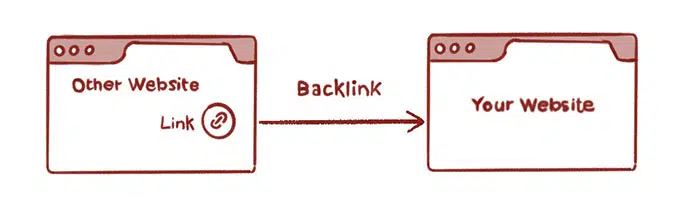
Backlinks define Authority
Before finding sites with a similar authority to yours, you need to know your authority. PA, the Page Authority is just the authority for a specific page, the homepage by default. And DA Domain Authority applies to the entire website.
You can use Moz SEO Toolbar to get a brief idea (1000 free requests per month).
Example:
This is the result for veryprivategallery.com, our website:
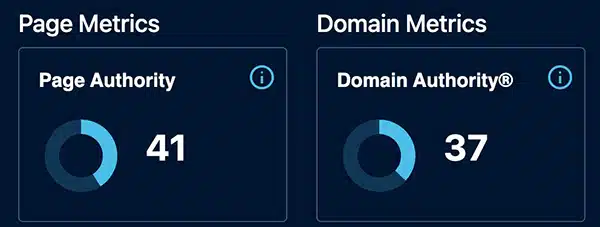
It means you need to aim for a DA around your current one. In theory, the higher the better, but likely you will have a better chance of getting an answer from a similar or lower authority than yours. In the best of the world, if you have awesome content on your website, others will link to it. Social media can help your site be discovered. But you can pursue proactive methods to get links.
Domain Authority scale
Domain Authority is a metric (created by SEO software provider Moz) that scores a website from 0 to 100 and predicts how well it will rank in search engines. It is subjective and unofficial, but it's the standard for measuring a site's "link power."
DA uses a logarithmic scale: growing your site from 10 to 20 is relatively easy, but moving from 30 to 40 requires more effort and higher-quality backlinks.
Authority breakdown in art on the Web:
- DA 10–20: The starter phase
Brand new or very casual sites. It is easy to grow in this tier using basic links (social media profiles, local directories). Traffic is minimal and relies mostly on direct links rather than search.
Example: A good personal portfolio website.
- DA 20–30: The emerging presence
Small but legitimate. It can start ranking for specific or localized searches.
Example: A local neighborhood gallery or a growing hobbyist art blog.
- DA 30–40: The competitive threshold
"Easy" links no longer move the needle. Breaking past this wall requires active digital PR, high-quality content, and earned editorial links from authoritative sites. You are now competing with established businesses.
Example: supersonicart.com (DA 35), veryprivategallery.com (DA 37)
- DA 40–60: The industry player
You are now a trusted authority. Other websites in your industry link to you naturally as a reference. You can rank for profitable, moderately competitive keywords.
Example: beautifulbizarre.net (DA 50), thinkspaceprojects.com (DA 49)
- DA 60–80: The household Name
You have a massive backlink profile built over years of high-level press and industry dominance. New content published on your site often hits the first page of Google almost instantly.
Example: artnews.com (DA 74), juxtapoz.com (DA 71)
- DA 80–100: The global giant
Internet titans. They dominate the market for broad, highly lucrative search terms (like "modern art" or "buy paintings"). Smaller sites can only outrank them by being hyper-specialized in a specific sub-niche.
Example: moma.org (DA 86), artsy.net (DA 82)
3 types of backlink requirements
Before getting into the ways to get backlinks, let’s see what kind of backlinks you can require:
1. Link insertion
Link insertion involves placing your hyperlink into an existing article on another website. In fact, all three are Link insertion; this first type is the simplest way to ask for a link.
2. Guest posting
Guest posting is a link insertion, except that you are the author of the article. This method is the most time-consuming link, as you will need to write for the website that provides the link. The site owner receives free content, and you receive a backlink. Plus, websites clearly state whether they ask for this kind of contribution.
3. Link exchange
Link exchanges are easy for Google to detect and rarely boost authority because they are seen as optimization rather than natural. So a safer approach is an indirect exchange: Site A links to Site B, and Site B links to Site C: the domain linking to us must not be the same as the one we’re linking back to.
Articles about SEO:
- Art keywords
- Artist websites backlinks
- Content for artist websites
- Art website name ideas
- SEO tips for artists
How to get backlinks?
What label do people put on your art, and in which category are you as an artist?
For this example, we will take “textile artist”. Now you need to find website owners who are passionate about textile art.
Use Google search with two methods:
BROKEN LINK METHOD
1. Find the good page
This method involves finding a website with broken links. Broken links are links that lead to nothing. By contacting the owner and letting them know their link is broken, you're providing a service, and you could ask that your site is the perfect replacement for the link's destination.
- "textile artists" + links
(This searches for pages that contain the exact phrase "textile artists" AND also include the word "links".) - inurl:links intitle:"textile artists"
(inurl:links tells Google to only show pages where the word "links" is actually in the URL) - Intitle:"textile artist list"
- intitle:"textile art list"
- "textile artist" inurl:blog
- "textile artist" inurl:magazine
- "textile artist spotlight"
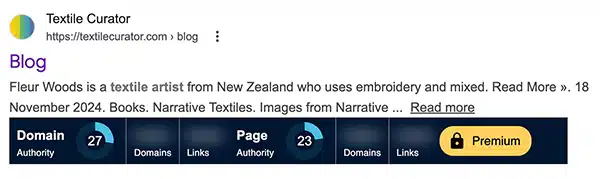
With the search: "textile artist" inurl:blog, I find: textilecurator.com
After checking, the blog is still active and publishing as of today. The DA of 27 indicates that it is a serious blog, yet reachable. Small but legitimate.
2. Look for the broken links in the site
Now I use BrokenLinkCheck for free and find there are 8 broken links on the sites. One of them is on this page (You can also use Screaming Frog, a reference software with free access):
https://textilecurator.com/janine-heschls-top-tips-for-realism-in-thread/
3. Contact to get to a talk
Don't ask anything, just show your interest, point out the link problem, and get first contact. "Internet is a table for two": people on the other side are human, not statistics; if you take the time to get to know them and are genuinely interested in what they do, it will always be a better chance to work.
Hi Helen,
Discovered your blog about a month ago while googling textile art, and I've been enjoying it ever since. My practice as an artist is on this material, so it's been cool to find your space and your book. Do you plan to sell it in a digital version in the future?
In your post about the interview with Mulyana, the link to the artist's website is broken; the artist now has a community website: https://www.mogus.id/
I might be too "emerging" to be chosen for one of your interviews, but I'd love to be considered for your ongoing project.
Best,
[Your Name]
GUEST POST METHOD
The idea here is to find websites that are asking for contributions. So it is a much simpler way to ask for a link, but in return, you will need to write something decent.
- "write for us" "textile art"
- "write for us" "textile artist"
- "guest post" inurl: "textile art"
- "submit a guest post" "textile art"
- "contributing writer" "textile art magazine"
- "write for us" "textile art"
- "write for us" "textile artist"
I searched with "write for us" "textile art" and found: Selvedge Magazine
https://www.selvedge.org/collections/contribute-to-the-blog
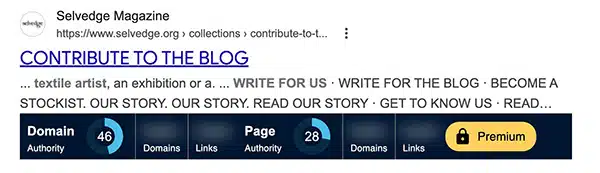
The guidelines on the page are clearly explained, and there is a contact email. Just need to get the work done!
Final tips about backlinks
1. All links must come from secure websites
The website needs to be HTTPS (SSL secured, with a 'lock' icon next to the URL). Avoid spam sites and domains hosting sensitive material. You can verify page quality using tools like Website SEO Checker.
2. All links must come from art-related websites
Would you rather have a link from a curator's blog or a beauty magazine? It will have more value if it's related to art or the subject matter. For example, if you are a feminist activist artist fighting for equal rights with your art, the backlink doesn't need to be from an art site. The link can be from any website article about politics, social studies, or legal studies.
3. Ask for a DoFollow link
Even if it is not as important as before, ask or check for a DoFollow link. A NoFollow link isn't great. You can use Seography link checker for free.
https://seography.io/tools/nofollow-links-checker
4. Links from Social media don't count
Links from social media do not add value to your SEO. The only benefit they provide is traffic to your website. Search engines like Google will not consider links from social media posts or stories.
5. Links from art galleries
Links from galleries are great, but few galleries will agree to link. After all, they are the middlemen. They could potentially lose business if they embed a link to your website. You should convince them or switch to a more open-minded gallery partner. And if you have a price catalog on your website, it must be on the same page as your galleries. You can't price your art cheaper on your own site than on the gallery's.
6. Search your niche
Whatever visual expression you are making, someone else in the world could have been working in a similar direction. When you search for your kind of art, you can also find out what others are doing and how they are perceived.
For example, if you are in abstract art, search for the galleries and artists in this niche. Contact them, and learn from them. Search for Google Images to learn how people view abstract art in this country or language. It might inspire you in many ways.
7. Be social
Would you like to be a reference in your niche with many great links? You can't do it all by yourself. You need to connect with others who share the same interest. "The Internet is a table for two." However, we tend to forget that they are real people on the other side of the screen, requesting a link from us (and vice versa). Forget about links for one moment. Ask about the person you are contacting, their projects, future plans, and even life stories. Invite them for a video chat. Once you establish a human connection, everything else should just unfold naturally.
8. Be careful with paid backlinks
Another way to get backlinks is to pay for them.
Selling backlinks is considered Black Hat by Google because it manipulates search results and may trigger a manual action penalty.
People who create websites are generally referred to as operators of Link Farms or Private Blog Networks (PBNs). Most of these links are low-quality and will only hurt your website's authority.
A good way to detect them as bad is simply when they sell a one-time payment for a permanent link. Let's kill a myth: there's no such thing as a good, permanent backlink with a one-time payment. A reliable link vendor is constantly engaged in maintaining its content; They will rent, not sell, links.
On our side, we provide links to art professionals in the community. It can be interesting to help increase your website authority as part of a linking strategy. Everything is explained on the community's forum.