
14 Different Types of Art Fairs
WHICH ART FAIR IS FOR YOU?
When people talk about art fairs, it's easy to reduce them to buying and selling, but that's only part of the story. Each fair is its own ecosystem, with its own hierarchies and gatekeepers, and they are not all built the same. It shapes:
- which artist's visibility,
- what artwork sells,
- which taste amplified.
In the sections below, I'm going to sort fairs into a few practical types and share what each one is actually like on the ground, so you can pick the ones that make sense for what you're trying to do.
↓


Art Basel
1. Blue-chip art fairs
Art Basel (Basel, Miami, Hong Kong, Paris), Frieze (London, New York, Los Angeles, Seoul), ARCO (Madrid, Lisbon)
The fairs that sit at the top of the art-fair hierarchy. They are gathering blue-chip galleries, museum-level works, and collectors, including institutional buyers and museum acquisition teams. Galleries usually go through a competitive selection process, in which they must demonstrate curatorial strength, the standing of their artists, and a record of institutional recognition.
Selection criteria
ARCO Madrid makes this especially explicit. It evaluates gallery applications using a 100-point system, with each of the 11 Organizing Committee members scoring submissions independently, for a total maximum of 1100 points.
The criteria are as follows (Example from ARCO Madrid):
- the gallery's exhibition project (35 points),
- the quality and consistency of its exhibition program (30 points),
- the presence of its artists in museum and institutional collections (20 points),
- past participation in ARCO Madrid (5 points),
- experience in other top-tier international fairs (5 points),
- media presence, including gallery listings, catalogs (5 points).
The system rewards recognition that is beyond commercial success. These fairs do more than host sales and signal status, and indicate that a gallery has reached a certain level of legitimacy.
Ticketing as a Gatekeeping Tool
There is a similar pattern on the visitor side. Ticket prices are high enough to keep the event feeling like a premium rather than a casual day out. For example, a ticket for Art Basel is about $78, while a multi-day pass costs about $283.


Art fair articles:
- Are Art Fairs Worth It?
- ARCO Lisbon
- ARCO Madrid
- Art fairs for individual artists
- Different types of art fairs
- Superfine art fair review
- What is an art fair?

London Art Fair
2. Regional top-tier art fairs
London Art Fair, Art Madrid, Art Cologne, Seattle Art Fair, Art Dubai, Art Beijing
Regional top-tier art fairs draw established galleries and collectors from the area, along with a small number of international visitors. They do not have the same global pull as blue-chip fairs. However, they can be strong commercial platforms and important visibility moments for artists and galleries working within a particular market.
Different regions, different sizes
Regional top-tier fairs are often named after their host city, which is usually a capital city. Their scale depends on the strength of the local market. It is advised to set a primary goal when planning to attend one of them:
- sales,
- visibility,
- network,
- learning how the fair circuit operates.
For example, the Seattle Art Fair featured more than 90 galleries. London Art Fair: 120 galleries; Art Dubai: 70. In contrast, Art Madrid had around 40 galleries, primarily from Spain. A fair with a smaller market may be more selective, but it will also have less noise and allow more time for real conversations.
Tips: Start smaller and move up
Think of these fairs as a progression, not a one-shot opportunity. If you can't get into your city's leading fair yet, it's often smarter to aim for a strong regional fair in a smaller market and build from there. A London gallery that doesn't make the cut for the London Art Fair's main gallery program, for example, might still have a decent spot at Art Madrid. The fair gets to look a bit more international, and the gallery receives something practical in return: a real fair experience, new collector contacts, and a stronger CV for the next application.
Even if they don't have the global attraction, regional top-tier fairs still matter locally. They can be used as a way to figure out:
- how your program reads in a crowded environment,
- what kind of work people stop for,
- and how you want to price and present yourself.
Over time, that adds up to the type of track record that makes bigger fairs easier to reach.


Liste Art Fair
3. Satellite art fairs
Liste (Basel, focused on emerging art, runs alongside Art Basel), SCOPE (Miami, New York, Basel, held alongside Art Basel and The Armory Show), VOLTA (New York, Basel, runs alongside Art Basel), and JustMad (Madrid, held during ARCO Madrid)
Satellite or parallel art fairs appear during the week of the major fair. The big fair sets the agenda, and the satellites catch the traffic. The number of parallel fairs can be overwhelming during these art weeks. Collectors, curators, and advisors have limited time and attention, and the more events there are, the harder it becomes to stand out. In Madrid, for example, the city hosts several concurrent fairs during ARCO week. Many visitors simply do not have the stamina to do more than one or two in a day. Consequently, smaller fairs without a clear identity or a distinct niche struggle the most. For galleries and artists, the real challenge is not about getting accepted but being noticed once the doors open.
Tips: How to "play" satellite fairs
From what I have seen, satellite fairs often develop a stable core of returning galleries over time, and that creates an internal hierarchy. If you are entirely new, it is realistic to expect a less visible booth location at first. A better strategy is to treat one satellite fair as a long-term relationship rather than a one-off opportunity. Then, with time, build familiarity with the organisers and audience, and learn how the fair's ecosystem works, you are more likely to secure better placements in successive editions. Consistency tends to be rewarded more than jumping from one parallel fair to another each year.


Affordable Art Fair HK
4. Affordable art fairs
Affordable Art Fair (global editions), Discoveries Collection at Red Dot Miami.
The term "affordable art fair" refers to both a general market category and the well-known global brand, "Affordable Art Fair", which has shaped this niche since its launch in 1999. With editions worldwide, it is, with few exceptions, only gallery-focused. The concept is built around attracting new and younger collectors. They often have a price ceiling of around $10,000 per artwork.
Other fairs also position themselves around affordability, but they do it more loosely. Instead of strict price caps across the whole fair, they have dedicated sections for lower prices.
Example: Red Dot Miami's Discoveries Collection has selected works priced at up to $3,000. The overall goal is similar: to lower the barrier to entry and make art buying feel less intimidating.
Tips: A double-edged label
Qualifying your work as "affordable" will help you reach new buyers, but it also shapes price expectations. In the future, that expectation will be hard to shift. One way to go about it is to build a defined "entry-level" body of work, separate from your main pieces. That way, you can welcome new collectors without locking all your art into a single price bracket.
Applying as an individual artist
Affordable Art Fair applications are usually open to galleries, dealers, and established collectives. If you are applying as an individual artist, the most reliable step is to contact the specific edition you are interested in and confirm whether they accept solo applications.


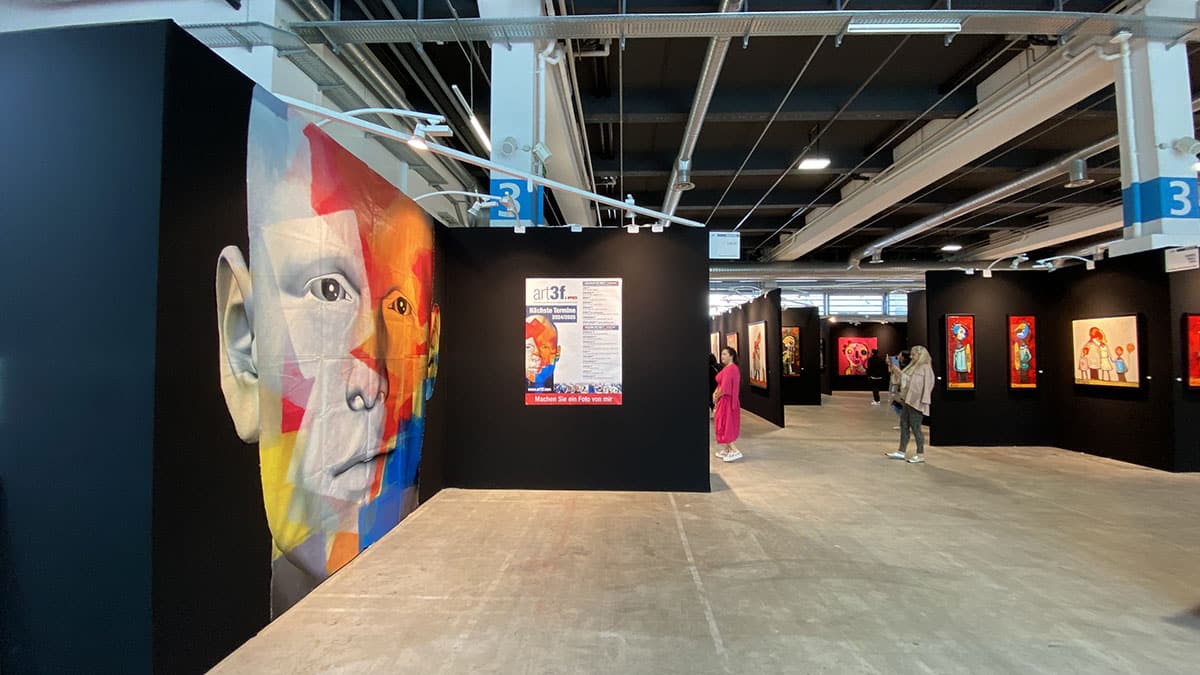
Art3F Zurich
5. Franchise art fairs
Art3F (operates in 14 cities across 6 European countries)
Franchise art fairs are the "chain-store" version of a fair. The name stays the same, the setup feels familiar, and the organizers repeat the formula in different cities. Art3F is the clearest example of this model. Its editions have been held or announced in the following cities: Barcelona, Bordeaux, Brussels, Dortmund, Haute-Savoie, Kortrijk, Lausanne, Luxembourg, Lyon, Marseille, Milan, Monaco, Mulhouse, Nantes, Paris, Reims, Strasbourg, Toulouse, and Zurich.
If you learn how one edition works, you can reuse the same booth plan, inventory strategy, and sales routine in other Art3F fairs. Nevertheless, the quality depends on the local organization. Some editions feature a hybrid environment in which artists show independently alongside established galleries. That can make the fair more open and varied, but it can also make some galleries cautious about how the event reads in terms of positioning. On the organizer's side, touring formats and a broader exhibitor base keep the business model stable.
Tips: Pick the editions that actually work
Be selective about which city you choose. Go for the editions with a good track record. A good reminder of why this matters is Art3F Barcelona. The second edition was scheduled to open on April 11, 2025, but it was postponed only a few weeks before launch due to technical and logistical issues. As of February 2026, new dates still had not been announced. When an edition is new or unstable, you take on extra risk, even if the brand name looks familiar.


FigBilbao
6. Niche art fairs
Paris Photo (Paris), FigBilbao (Works on Paper, Bilbao, Spain), Drawing Now Paris (Paris), Drawing Room (Lisbon), London Original Print Fair (London), IFPDA Print Fair (New York), Urban Art Fair (Paris)
Niche or specialized art fairs focus on a specific medium, such as photography, printmaking, or urban art. The scope is narrower, so the audience is more targeted. These fairs tend to attract collectors, specialists, and institutions with a deep interest in that field, making them an efficient way to reach the right buyers and build long-term relationships without getting lost in the noise of the broader contemporary art market.
It can be hard to stand out at these fairs: The competition can be smaller, yes, but it is more concentrated. You will be dealing with an informed environment. A booth that feels generic, under-researched, or out of place will make potential buyers go away.
Tips: Depth matters here
Do not assume that a niche fair automatically means less competition. Even with fewer exhibitors, the standard is often higher because everyone is specialized, and visitors usually know precisely what they are looking for. In broader fairs, hype, branding, and trend-following can sometimes compensate for a lack of depth. In specialized fairs, that is much harder. To do well, you need a clear artistic identity, strong presentation, and enough knowledge of the field to speak the same language as collectors and professionals.


Superfine Art Fair
7. Art fairs for individual artists
The Other Art Fair (global), Superfine Art Fair (U.S.), Clio Art Fair (New York) In the sections above, I mentioned that some fairs occasionally allow solo-artist presentations, but for most fairs, that remains secondary to their core model, which is built around galleries. Artist-focused fairs work differently. They are designed for artists to exhibit and sell without the need for a gallery. These fairs create market opportunities for artists who prefer to be in control.
Tips: Know the whole cost structure
Their financial terms vary, and some charge a commission on top of booth fees. The Other Art Fair, for example, takes an additional 18% commission on sales, plus the payment for your stand. Organizers justify this by covering transaction handling and buyer-facing services such as packaging or artwork wrapping. Before applying, it helps to calculate your real costs realistically, including commission, production, transport, insurance, and the value of your time.
We wrote a full article on the subject.


Flecha Art Fair
8. Alternative location art fairs
Hybrid Art Fair (Madrid, held in hotel rooms), Flecha Art Fair (Madrid, in shopping malls), Accessible Art Fair (Brussels, held in luxury hotels), The Others Art Fair (Torino, in a training center)
Alternative location art fairs ditch the usual rows of booths and take over places like hotels, shopping malls, and other public spaces. In this format, the venue isn't neutral. It affects how you see the work, how you move through the event, how long you linger, and who ends up stopping by. Because these fairs take place in everyday spaces, they often attract people who wouldn't usually visit art fairs.
Hybrid Art Fair
The fair uses hotel rooms as exhibition spaces. Situated in Madrid, it has built a consistent community over the years. The setting creates a different kind of viewing experience, closer and more informal than a typical fair hall. A practical advantage is that artists and gallerists can stay in the same rooms where they exhibit, reducing accommodation costs and eliminating daily commuting across the city.
Flecha Art Fair
Flecha Art Fair takes a very different approach. Founded in 1991, it turns a shopping mall on the outskirts of Madrid into an exhibition environment that lasts a month. The fair displays a large volume of works, so visitors encounter art as they go. A central desk handles the sales. This setup exposes the work to an audience that may not have intentionally entered a gallery or fair.
Accessible Art Fair
Accessible Art Fair sits slightly closer to a conventional art fair format, but still uses the hotel environment as part of its identity, often staged in a lobby or shared hotel spaces. The format retains the recognizable look of an art fair while drawing on the relaxed social atmosphere of a hotel.
Across these examples, the main point is that alternative venues change how art is seen and who gets to see it, and can make the experience feel less formal for first-time buyers.
Tips: Plan for unwanted handling
Before you commit to an alternative-location fair, consider what happens when you exhibit in a carefully controlled space. In public venues, people get closer, crowds bump into things, and kids reach out. You'll need to plan with practical protections that don't ruin the viewing experience.


London Contemporary Art Fair
9. Group Show art fairs
London Contemporary Art Fair by ITSLIQUID (London), the New Artist Fair (London)
These "group show" art fairs resemble gallery group exhibitions more than conventional art fairs, even though they operate on a recurring schedule and use the language of fairs. Participation is generally fee-based (aka pay-to-play) and focused on individual artists or small artist groups. Instead of renting a full booth, artists pay a fee to show one work or a small selection. Because the format is closer to a rotating showcase than a market platform, the experience and outcomes can be very different from what people expect when they hear the term "art fair."
London Contemporary Art Fair
The London Contemporary Art Fair, run by the Venice-based ITSLIQUID Group, takes place several times a year in London, usually in a local gallery space. The setup is pretty simple. Artists apply online, selected artists pay a participation fee, and then ship their work in by courier. The venue installs everything, so you don't have to travel or be there in person.
The downside is that it doesn't work like a typical art fair: The event functions more as a showcase for visibility than for direct sales.
Tips: Showing up matters
The format really needs the artist's presence, as it gives people a reason to ask questions and connect. Otherwise, a quick look won't turn into a follow-up message or a studio visit. If you're not there, the show can end up feeling like a static display where visitors.


Pitti Immagine Uomo
10. Design art fairs
Pavilion of Art and Design (Paris, London, Geneva, decorative arts), Collect (London, contemporary craft and design), Salone del Mobile (Milan, interior design and furniture), Pitti Immagine Uomo (Florence, men's fashion)
Design-focused fairs can be about collectible design, contemporary craft, decorative arts, and fashion. In addition to the general audience, there are architects, interior designers, and stylists, so the sales dynamics differ from those at other art fairs. Purchases can be made in batches, and there are opportunities for higher volume, but it also raises the bar for presentation and market fit. To stand out, work usually needs a clear identity, strong materials and finish, and a visual or functional appeal that translates easily into interiors or wardrobes.


Der Berliner Kunstmarkt
11. Open-air art fairs
Montmartre Artist Market (Paris), Berlin Art Market by the Zeughaus (Berlin), Fine Art Market (Seville), Art in the Pearl (Portland), Plaza Art Fair (Kansas City), Silverlake Flea (Los Angeles)
Open-air art fairs take place in squares, parks, and pedestrian streets. The atmosphere there is informal, and the audience broader than at other fairs. Visitors often discover the event as they walk through the city. Because prices are lower, these fairs support cash-and-carry purchases. Artists make pieces that travel and are displayed quickly, and appeal to a broad public. Work that is fragile, highly installation-based, or difficult to transport is generally at a disadvantage.
Tips: Bring an extra pair of hands
Outdoor fairs are physically demanding. Better if you bring someone with you for setup and breakdown. The weather is also a fundamental factor, and you may need to protect your work in just minutes. Be prepared with sturdy display systems, weights, and waterproof coverings.


Parallax Art Fair
12. Co-op art fairs
Parallax Art Fair (UK), The New Art Dealers Alliance (U.S.), BUTTER Fine Art Fair (Indianapolis), Geneva Arts Fair (Geneva, Illinois)
Equity, accessibility, and community are their main principles. Organized by associations or collectives, co-op art fairs aim to reduce barriers to participation. In some cases, the nonprofit status reflects a genuine mission. In others, "nonprofit" is a facade to businesses built on fees or sales.
Parallax Art Fair
Parallax Art Fair is often cited for its lower participation fees than those of other London art fairs. It isn't a high-profile event, but it has the backing of Kensington Town Hall, which gives it institutional support. Some options start at around £35, which makes it possible for early-career artists to take part without committing to an expensive booth. It isn't a nonprofit, but they are not taking a percentage of your sales. The fair doesn't handle payments, so you manage the sales conversation.
The low fee makes the event have less to spend on marketing, PR, and collector services. Some co-op fairs do build a steady audience over time, but others remain modest in reach. In this context, "success" isn't about sales and more about testing the waters, meeting people, and learning to operate in a fair setting.
Tips: Don't rely on the fair to sell for you
Co-op fairs often don't have the kind of sales infrastructure you see at more commercial events. Collectors may still come, but sales are usually not the main engine of the fair, and transactions are often left to the artists. If you want to make it work, you will need to run your own mini-campaign: invite people in advance, bring your own Point of Sale.


Feriarte
13. Modern art and antiques fairs
TEFAF (Maastricht, New York), Frieze Masters (London), Feriarte (Madrid), BRAFA Art Fair (Brussels), The Winter Show (New York), Art & Antique Budapest (Budapest)
Modern art and antiques fairs revolve around historically anchored markets. They feature old masters, antiquities, fine furniture, and jewelry. Their demand is shaped by scholarship, historical importance and condition. Reputation matters, and authentication checks can be expensive and non-negotiable. Yet there is a possibility for artists or galleries to participate with art related to the theme, whether modern or antique, as long as it is relevant.
Art & Antique Budapest
With 50 leading galleries presenting works ranging from paintings and sculpture to furniture and jewelry, the fair brought together classical and contemporary art on a large scale. What I found especially striking was the depth of the mix. It was not just a matter of antiques in one corner and contemporary art in another, but a much more thorough blending of antique collectables, modern art, and contemporary works throughout the fair. I had not really seen that kind of integration to the same extent elsewhere. The clientele also felt unique because the demographic was very diverse, which gave the fair a distinct atmosphere and a broader range of energy than at more narrowly defined events.


Feriarte
14. Context-driven art fairs
1-54 Contemporary African Art Fair (London, New York, Marrakech, focused on contemporary art from Africa and its diaspora ); Also Known As Africa (Paris), MIRA Art Fair (Paris, contemporary Latin American art), Darwin Aboriginal Art Fair (Darwin).
Some fairs are organized around context rather than medium or price. I'm using "context-driven," and sometimes I refer to this group more playfully as "Global South art fairs". Fairs that center scenes and markets from places like Africa and Latin America.
1-54 Contemporary African Art Fair
1-54 is one of the most established examples of fairs representing African contemporary art (and its diaspora). Editions are in London, New York, and Marrakech. Its success shows how a cultural focus can combine curatorial position and market strategy.
MIRA Art Fair
A similar setup exists for Latin American art. MIRA Art Fair in Paris is dedicated to contemporary Latin American work. They had more than 20 galleries specializing in the region. It served as a focused meeting point in Europe for people specifically seeking Latin American artists and galleries, creating a dynamic distinct from that of a general contemporary fair.
Room to grow
What's interesting is that Europe still doesn't really have an equivalent fair that is clearly and exclusively dedicated to Asian art. Asian artists and galleries are present everywhere, and there are plenty of "Asia weeks" and Asia-related programming, but a single, well-defined fair built around Asia as the organizing category hasn't properly taken shape. Given how crowded the fair calendar has become, that absence stands out. It feels like one of those gaps that could eventually turn into a new niche, especially as fairs look for sharper identities to separate themselves from the rest.


Final thoughts
From blue-chip fairs at the top of the market to artist-led initiatives at the bottom, the art fair landscape is far more diverse than the term suggests.
The right fair depends on career stage, audience, and budget. Fairs can be a calculated access to collectors, curators, and institutions that are hard to reach otherwise. But the cost can be steep, and you spend a significant amount of money for a few days, with no guarantee of a return. Many galleries had to close their business after this investment. The key is to leap without breaking a leg.